How Much Vitamin D Can You Get From the Sun
ARCHIVED CONTENT: As a service to our readers, Harvard Wellness Publishing provides access to our library of archived content. Please note the date each commodity was posted or final reviewed. No content on this site, regardless of date, should ever be used equally a substitute for straight medical advice from your doc or other qualified clinician.
Missing out on the "sunshine vitamin" has consequences for more than just os health.
September brings the end of summer in the northern hemisphere and, for many of u.s.a., that means less time in the sun. The dominicus's rays provide ultraviolet B (UVB) energy, and the skin uses information technology to kickoff making vitamin D. (The pare actually produces a precursor that is converted into the active form of the vitamin past the liver and kidneys.) Vitamin D is all-time known for its vital role in bone health. Without this "sunshine vitamin," the body can't blot the calcium it ingests, so information technology steals calcium from bones, increasing the risk of osteoporosis and fractures. Vitamin D also helps maintain normal blood levels of phosphorus, another os-edifice mineral.
Vitamin D would be essential if it did nothing else. Merely researchers have discovered that information technology's active in many tissues and cells as well bone and controls an enormous number of genes, including some associated with cancers, autoimmune disease, and infection. Hardly a month goes past without news about the risks of vitamin D deficiency or about a potential office for the vitamin in warding off diseases, including breast cancer, multiple sclerosis, and fifty-fifty schizophrenia. In June 2008, a study published in the Archives of Internal Medicine establish that low blood levels of vitamin D were associated with a doubled take chances of death overall and from cardiovascular causes in women and men (average age 62) referred to a cardiac center for coronary angiography. At a scientific meeting in May 2008, Canadian researchers reported that vitamin D deficiency was linked to poorer outcomes in women with breast cancer. And a large report of aging in kingdom of the netherlands published in the May 2008 issue of Archives of General Psychiatry constitute a human relationship between vitamin D deficiency and depression in women and men ages 65 to 95.
The picture of vitamin D'due south health benefits across bones has been fatigued mainly from epidemiologic and observational investigations. The findings of such studies can suggest correlations between disease risk and sure factors — sun exposure or claret levels of vitamin D, for instance — simply they don't bear witness cause and consequence. Promising findings from observational studies don't always pan out when put to the test in clinical trials. However, in one of the few randomized trials testing the upshot of vitamin D supplements on cancer outcomes, postmenopausal women who took 1,100 international units (IU) of vitamin D plus 1,400 to one,500 milligrams of calcium per day reduced their adventure of developing non-pare cancers by 77% later on four years, compared with a placebo and the same dose of calcium. The one,100 IU dose — nigh three times the 400 IU per day recommended in federal and other expert guidelines — was correlated with a 35% college blood level of vitamin D, on average. In the but other randomized trial of vitamin D and cancer — role of the Women's Health Initiative — researchers institute no effect on colorectal cancer. Critics say that the dose, 400 IU per twenty-four hour period, was likewise minor to brand a difference.
More trials are needed to elucidate vitamin D's benefits and risks at different doses and in different populations. In fact, a big-scale randomized trial that would include 20,000 U.S. women and men has been proposed by Harvard researchers and volition be considered for funding by the National Institutes of Health. In the meantime, the prove is so compelling that some experts already recommend at least 800 to one,000 IU of vitamin D per twenty-four hours for adults.
Latitude and vitamin D production in the peel
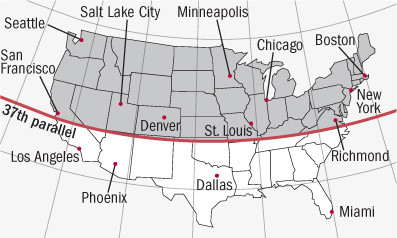
Except during the summertime months, the peel makes little if any vitamin D from the lord's day at latitudes to a higher place 37 degrees northward (in the United States, the shaded region in the map) or below 37 degrees s of the equator. People who live in these areas are at relatively greater risk for vitamin D deficiency.
In search of vitamin D
Under the right circumstances, 10 to fifteen minutes of sun on the arms and legs a few times a week can generate nearly all the vitamin D we need. Unfortunately, the "right circumstances" are elusive: the season, the time of twenty-four hour period, where y'all live, cloud cover, and even pollution touch on the amount of UVB that reaches your pare. What's more, your skin's production of vitamin D is influenced by historic period (people ages 65 and over generate merely ane-fourth equally much every bit people in their 20s do), pare colour (African Americans take, on average, virtually half equally much vitamin D in their blood as white Americans), and sunscreen use (though experts don't all concur on the extent to which sunscreen interferes with dominicus-related vitamin D production).
Lack of sun exposure would exist less of a problem if diet provided acceptable vitamin D. But there aren't many vitamin D–rich foods (see chart, below), and yous demand to eat a lot of them to get 800 to 1,000 IU per day. People who have problem arresting dietary fat — such every bit those with Crohn's disease or celiac disease — can't get enough vitamin D from diet no matter how much they swallow (vitamin D requires some dietary fat in the gut for absorption). And people with liver and kidney disease are often scarce in vitamin D, because these organs are required to make the active form of the vitamin, whether information technology comes from the sun or from nutrient.
| Selected food sources of vitamin D | |
| Nutrient | Vitamin D (IU*) |
| Salmon, 3.5 ounces | 360 |
| Mackerel, iii.5 ounces | 345 |
| Tuna, canned, 3.5 ounces | 200 |
| Orange juice, fortified, 8 ounces | 100 |
| Milk, fortified, 8 ounces | 98 |
| Breakfast cereals, fortified, 1 serving | 40–100 |
| *IU = international units Source: Office of Dietary Supplements, National Institutes of Health | |
For these and other reasons, a surprising number of Americans — more than 50% of women and men ages 65 and older in North America — are vitamin D–deficient, according to a consensus workshop held in 2006. Growing sensation of vitamin D'south benefits coupled with the risk of vitamin D deficiency has led some experts to recommend a claret exam that assesses the amount of vitamin D in the trunk. The examination measures the concentration of 25-hydroxyvitamin D3, or 25(OH)D, the forerunner produced by the skin and converted in the body to vitamin D. If you're over age 70, take darker skin, or live at a northern latitude, you might want to ask your clinician most the examination. People who have malabsorption problems or take medications that interfere with vitamin D activity (for example, glucocorticoids) should consider information technology besides. However, some experts think testing is unnecessary equally long every bit you get 800 to 1,000 IU of vitamin D a day.
Although there'due south no agreement on an optimal level of 25(OH)D, deficiency is by and large defined equally a blood level less than xx nanograms per milliliter, or 20 ng/mL (see chart). Levels that low have been linked to poor bone density, falls, fractures, cancer, immune dysfunction, cardiovascular disease, and hypertension. Many experts recommend a level of at least 32 and suggest that 800 to 1,000 IU of vitamin D per 24-hour interval is required to maintain that level.
| Vitamin D status past blood levels of 25(OH)D* | |
| Vitamin D condition | 25(OH)D in nanograms per milliliter (ng/mL) |
| Scarce | Less than twenty ng/mL |
| Bereft | twenty to 29 ng/mL |
| Sufficient | xxx ng/mL or more |
| Potentially harmful | More than than 150 ng/mL |
| *25-hydroxyvitamin D3 (vitamin D precursor) Source: Holick MF. "Vitamin D Deficiency," New England Journal of Medicine (July xix, 2007), Vol. 357, No. three, pp. 266–80. | |
How to attain 1,000 IU
Unless you live in the S and spend a fair amount of time outdoors, or you like eating lots of fat fish and vitamin D–fortified foods, supplements are the best way to brand certain you're getting 800 to 1,000 IU per day. (Higher doses may exist prescribed if you lot've been diagnosed with vitamin D deficiency.) Virtually multivitamins contain but 400 IU. Just don't only take ii, because getting double doses of other vitamins and minerals can exist unsafe (for example, too much vitamin A as retinol can cause hair loss and diarrhea and is associated with hip and other bone fractures, possibly due to an adverse interaction with vitamin D). Many calcium pills comprise about 200 IU of vitamin D, so one multivitamin and two or three calcium pills should suffice. Or you can take a vitamin D pill to round out your daily needs. Until we know more, brand sure your intake from supplemental sources doesn't exceed ii,000 IU per day, the current upper limit set by the National Academy of Sciences.
As a service to our readers, Harvard Health Publishing provides access to our library of archived content. Delight notation the date of last review or update on all manufactures. No content on this site, regardless of date, should ever be used every bit a substitute for direct medical advice from your doc or other qualified clinician.
Source: https://www.health.harvard.edu/staying-healthy/time-for-more-vitamin-d

Post a Comment for "How Much Vitamin D Can You Get From the Sun"