DIY preschool math games that help children develop number sense
© 2022 – 2022 Gwen Dewar, Ph.D., all rights reserved
Do kids improve their mathematical savvy past playing preschool math games? Studies suggest they can. Hither I provide instructions for creating games that have helped children boost math skills later on only 60-fourscore minutes of full play time. I also discuss the potential educational benefits of playing the traditional board game, Chutes and Ladders.
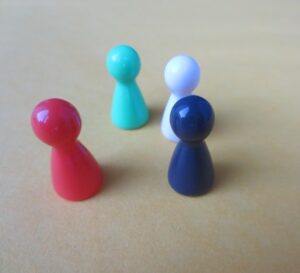
Race to the finish with this DIY preschool math game for 2 to 4 players
As I explain elsewhere, this preschool math game, called "The Corking Race," was designed by researchers to help young children develop an intuition for numbers (Ramani and Siegler 2008). They tested it on preschoolers who had been struggling, and afterwards just 4 game sessions totaling less than 80 minutes, these kids made substantial, lasting improvements in four areas:
- Numeral identification
- Counting
- Number line interpretation (in which a child is asked to mark the location of a number on a line)
- Numerical magnitude comparison (in which a child is asked to choose the greater of two numbers)
How does information technology work? It's depends on a gaming materials you lot tin can create yourself, using paper-thin, colored construction paper and a few part supplies.
For the game board, y'all'll demand:
- a piece of cardboard or heavy carte du jour stock that is at least twenty inches long
- structure newspaper in contrasted colors, or a set of colored marking pens
- pair of scissors
- glue and or tape
Yous'll also need a game spinner, which yous can make with
- cardboard or card stock
- scissors
- a marking pen
- a paperclip
- a fastening brad
Finally, you'll need some game tokens. You can borrow some from another board game, or use pocket-size toys.
How to brand the game board and spinner
The game board layout is a unproblematic, linear strip – a series of game spaces or squares, of roughly equal size. You can either make these game spaces from squares of colored construction paper (and glue them onto the cardboard equally shown beneath), or depict your game spaces directly onto the cardboard with colored mark pens.
Once you have created your row of spaces, label the outset infinite "Get-go" and the terminal infinite "Stop". Then label the remaining spaces with sequential numbers, so that the start space after "Start" is labeled "1", the next space is labeled "2", and so on. When yous're done you'll have something that looks like this:

For the game spinner, you need a circular face divided into at least four, equal, pie-shaped "slices." Y'all tin can describe this onto a piece of cardboard or card stock. Write numbers in each infinite, alternating between "one" and "two".
There are several different ways to create the spinning action. Hither'southward a elementary method using a paperclip. Start, poke a pigsty in the center of your "pie", as shown in this image.
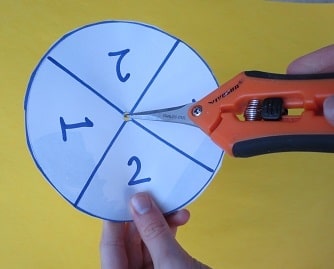
Adjacent, place a paper prune then that 1 open up end of it rests over the top of the pigsty. Insert the long ends of a brad through the newspaper clip and the hole, and so — on the reverse side of your spinner — secure the brad in identify by bending the long ends flat.
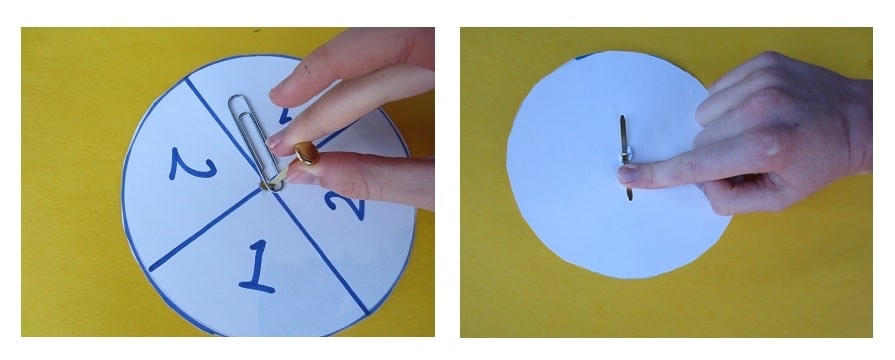
At present you should have a have a functioning spinner. Your paper prune should move freely effectually the centre when y'all flick information technology. If information technology'south fastened also tightly, adjust the brad as needed.
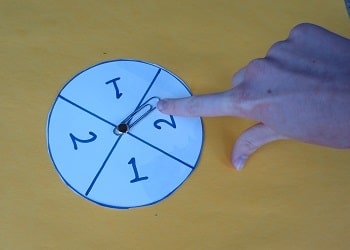
With your game tokens, lath, spinner, yous're ready for a game.
How to play
Players begin by placing their game tokens on the "get-go" space. Then players take their turns. Each turn looks like this:
- Motion-picture show the spinner, and phone call out the number that it lands on.
- Movement your token appropriately. For example, if the spinner landed on "1", yous move your game token one space frontward.
And hither'due south the nearly important part:
When players move their tokens, they don't recite the number of spaces they are moving forward. Instead, they use a tactic chosen "counting on": They phone call out numbers on the spaces through which the game piece moves.
For example, suppose we're in the middle of the game, and when I begin my plough, my token is resting on the "ii" infinite. I spin a "ii", so I need to movement my token ii spaces forward. But equally I move my token along, I don't say "One, two." I speak the proper name of each space that I pass through. "3, iv." If I spin a "ii" on my next turn, I will motility my token and say "Five, six!"
This is a bit counter-intuitive, and kids will sometimes forget the rule. If kids brand a mistake or forgets the proper name of a number, requite them a reminder and help them repeat the motility correctly.
The winner is the first histrion to move their game token to the concluding "stop" space.
Playing several games in a row
A single game tin be completed in a few minutes, then information technology'south easy to play a serial of matches dorsum-to-back. And that'due south what researchers did to get their results: Kids played iv or 5 games in a row every few days.
Number battle: A DIY preschool card game for two players
Board games aren't the only way to make learning about numbers fun. Researchers tested this menu game (called "War") on a iv-year-olds and constitute that it, too, can assistance preschoolers develop better "number sense." After just four, 15 minute game sessions — distributed over a period of 3 weeks — kids experienced marked improvements in their power to guess relative magnitudes. Children who had been lagging behind their peers were now fully defenseless-up (Scalise et al 2017).
What's required? For this game, you'll need to create a fix of playing cards. They volition be similar in size to standard deck of playing cards, and all the cards will look the same on the back.
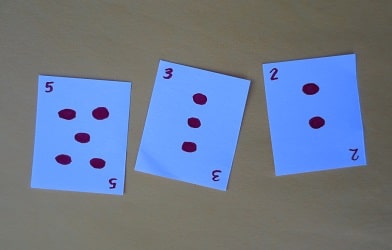
Simply on the front, each card will display a specific quantity (from 1 to ten). This will be depicted with both Arabic numerals, and with a set of dots matching the number.
Yous volition demand 40 cards in full — four duplicates for each quantity. For case, y'all volition have for 4 cards depicting the quantity "1", iv cards depicting the quantity "ii", and then on.
In the study, researchers displayed each card'south Arabic numerals twice (in the upper left and lower right corners). The dots were arrayed in the center of the card. Hither's an example:
How to play
In the researchers' study, each game was played past but two individuals — an adult and a kid. To begin, the adult deals the cards into two decks of twenty each, one for each thespian. The cards are stacked face downward.
Side by side, each player flips over the first card in her or her personal deck. Players read the number on their cards — out loud. If the kid can't read the Standard arabic numerals, show the kid how to count number of dots instead. Then ask the child to say which number is greater.
For example, in the epitome below, the kid should point that 5 is greater than 3.
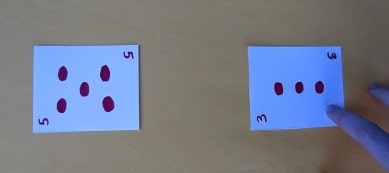
If the child makes has trouble making the judgment — or gets the reply wrong — encourage the child to look at the dots on each card. Which looks like more? Keep asking questions, and guiding your child through the problem, until he or she reaches the right answer.
Once your kid has identified the relative values of the numbers, the histrion with the menu of greater magnitude collects both cards, and keeps them in a special pile. And then each player flips over a new menu from his or her deck, and once again players name the numbers on their cards, and determine the number that is greater.
Keep repeating the process until players run out of cards in their decks. The winner of the game is the actor who has collected the nearly cards from each "boxing".
Chutes and Ladders
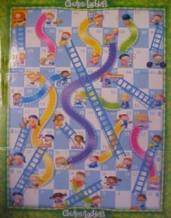
And then far, nosotros've talked most games that were experimentally designed to teach mathematical skills. What about older, traditional games? Can they be helpful also? Researchers retrieve information technology's possible.
In detail, Chutes and Ladders (a variant of the ancient Indian board game, Moksha Patam, also known as "Snakes and Ladders"), seems promising. Similar The Greate Race, Chutes and Ladders features consecutively-numbered game squares, and players accept turns to find out how many squares they can travel.
Of form, it's quite a bit more complex than The Great Race. The spaces are numbered from ane to 100, and the spinner permits players to move up to half-dozen spaces at a time. Virtually move is horizontal (forth rows), simply when a actor gets to the end of a row, he or she ascends to the next row above. And along the way, players may land on "ladder" squares which permit them to take a shortcut to one of the upper rows. Other "chute" squares force players to descend.
Still, the bones game mechanics are similar. Possibly — once kids take familiarity with numbers upwards to 100 — this game could exist used to help children develop their understanding of relative magnitudes.
In support of this idea, Elida Laski and Robert Siegler (2014) created a game very like to Chutes and Ladders, and tested it on kindergartners. Chiefly, they required children to utilize the tactic of "counting on," and, once again, this made a difference: Compared with children who skipped this tactic, kids who moved their game tokens by "counting on" experienced greater improvements in their ability to approximate relative magnitudes.
So when are kids gear up to learn these lessons from Chutes and Ladders?
In the experiments by Laski and Siegler, kids averaged 5.viii years in age. But chronological age probably matters less than a child's previous developmental experiences. I suspect that kids volition require a lot of coaching until they encounter these criteria:
- They are good at counting real-earth objects from 1 to 20
- They have been introduced to numbers through 100
- They are familiar with the layout of a filigree, and the idea of shifting from row to row along a grid
More games to play
For more research-based preschool math games, see these Parenting Science opens in a new windowpreschool number activities. And if you'd like to acquire more about the evidence that board games can help children develop number sense, see my article, "Tin can preschool board games boost mathematics skils?"
References: Preschool math games
Laski EV and Siegler RS. 2014. Learning from number board games: You learn what you encode. Dev Psychol. 50(iii):853-64.
Malofeeva, E., Twenty-four hour period, J., Saco, Ten., Young 50., & Ciancio, D. (2004). Construction and evaluation of a number sense exam with head start children. Journal of Educational Psychology, 96(4), 648-659.
Ramani GB and Siegler RS. 2008. Promoting wide and stable improvements in low-income children'south numerical knowledge through playing with number lath games. Child Development 79(2):375-394.
Scalise NR, Daubert EN, Ramani GB. 2017. Narrowing the Early Mathematics Gap: A Play-Based Intervention to Promote Low-Income Preschoolers' Number Skills. J Numer Cogn. three(3):559-581.
Content of "Preschool math games" last modified 11/8/2021
Portions of this text derive from an earlier, copyrighted version of this article by the same author.
Source: https://parentingscience.com/preschool-math-games/

Post a Comment for "DIY preschool math games that help children develop number sense"